Performance and Safety
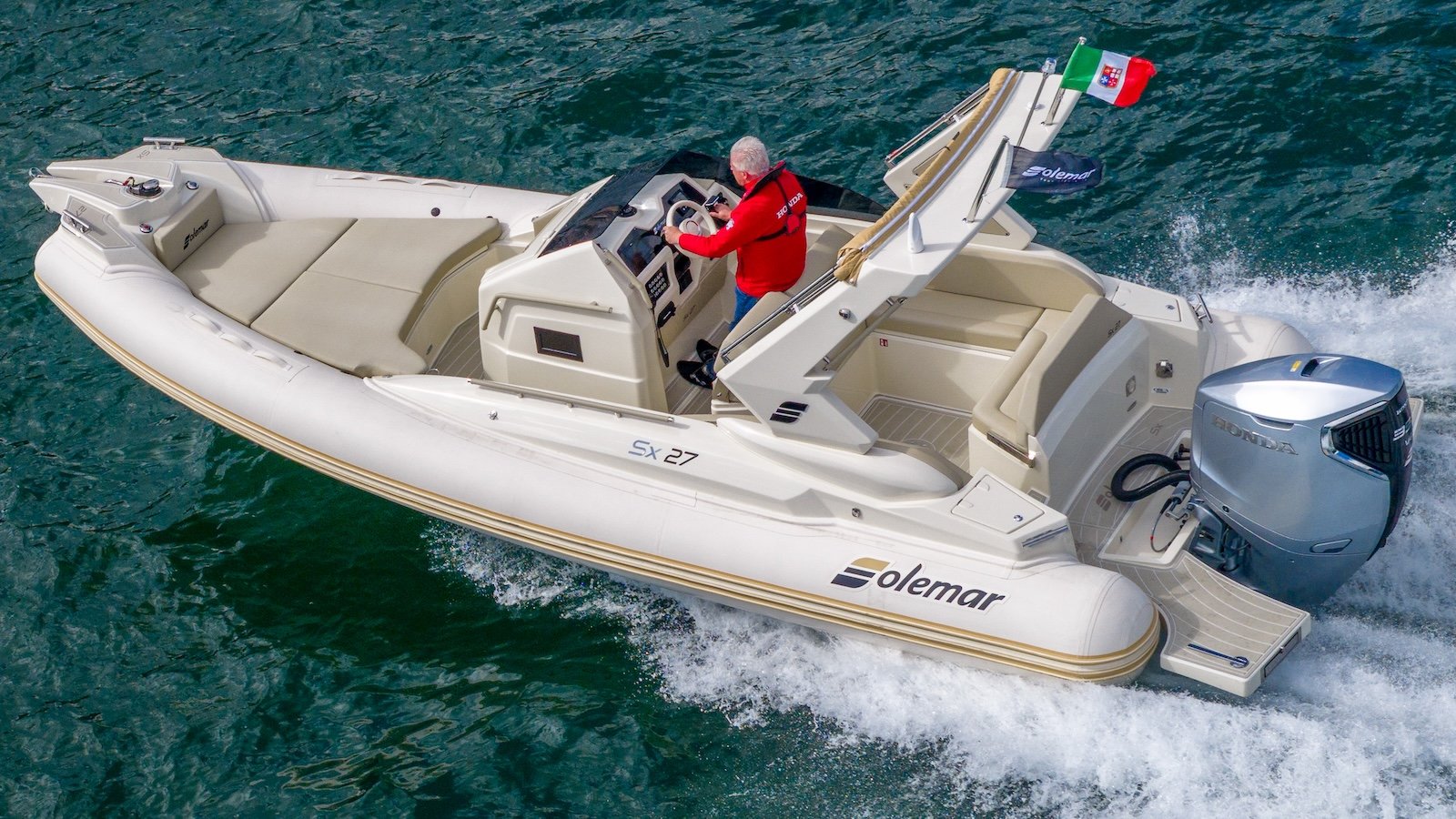
As soon as we cleared the harbor and found open water, I didn’t want to waste any more time. To see how this beauty gets up on plane, I pushed the throttles down. The thrust from this Honda V8 350 is mighty: in the blink of an eye, we are already on the plane and cruising at well over 26 knots. The feeling of acceleration is physical and decisive, yet smooth and never aggressive.
We then went in search of the ideal cruising speed. Throttling back slightly, we recorded extraordinary numbers: at 25 knots, the tachometer reads 3,200 RPM and fuel consumption sits at just 25 liters per hour. Accelerating to bring us to 30 knots, the revs rise to 3,800 and hourly fuel consumption stops at 39.9 liters. This is very interesting data, because we are talking about a truly high cruising speed that is perfectly sustainable for long passages. But the engine continues to amaze me: at this speed, we are only at 3,750/3,800 RPM, and we still have plenty left at our disposal.
It was then time to see how our Solemar SX27 performs at full throttle. Even starting from 30 knots, slamming the throttle down produces remarkable acceleration. The GPS climbs rapidly: 40 knots, then 45… I adjust the trim with millimeter precision to free up the hull… 49, and finally we cross the psychological barrier: 50.4 knots is the top speed reached by our Solemar SX27. And yet, as can be seen in the test video, even at maximum speed, the perceived level of safety remains very high.
Handling and Maneuvers: A Perfect Hull
To thoroughly test the hull, I slowed back down to around 30 knots and, without hesitation, put the wheel hard over to port. The Solemar SX27 tracks into position essentially flawlessly. We crossed our own wake waves repeatedly, but the RIB does not seem affected in the least. Even accelerating through the turn, this magical Maxi RIB never tends to wash out or drift wide, staying glued to the water as if riding on rails.
Counter-steering to starboard, the feeling is identical: you perceive great directional stability and an immense sense of security. Crossing the waves, of course, the boat physiologically lifts, but the deep-V hull cuts right through them without producing any violent impact or annoying pounding. Really not bad! Even entering a wide, fast arc, the RIB tracks through it without the slightest hesitation.
To conclude the dynamic analysis, we performed our customary standing-start acceleration test. After the countdown (3, 2, 1…), full throttle down! The results are thrilling: 10 knots, 20 knots, 30 knots, 40 knots… all the way to reaching 50 knots in just a handful of seconds!
A astonishing result. Having returned to a fast cruising speed of around 35 knots, I logged another fantastic data point: 4,300 RPM and only 52 L/h in consumption. At this speed, our average navigation pace will be extremely high, allowing us to easily reach even the most distant destinations. This result is made possible only by the winning combination of a masterfully designed hull and a great outboard engine.
Exploring the Exterior of the Solemar SX27: Comfort, Ergonomics, and High-Class Details
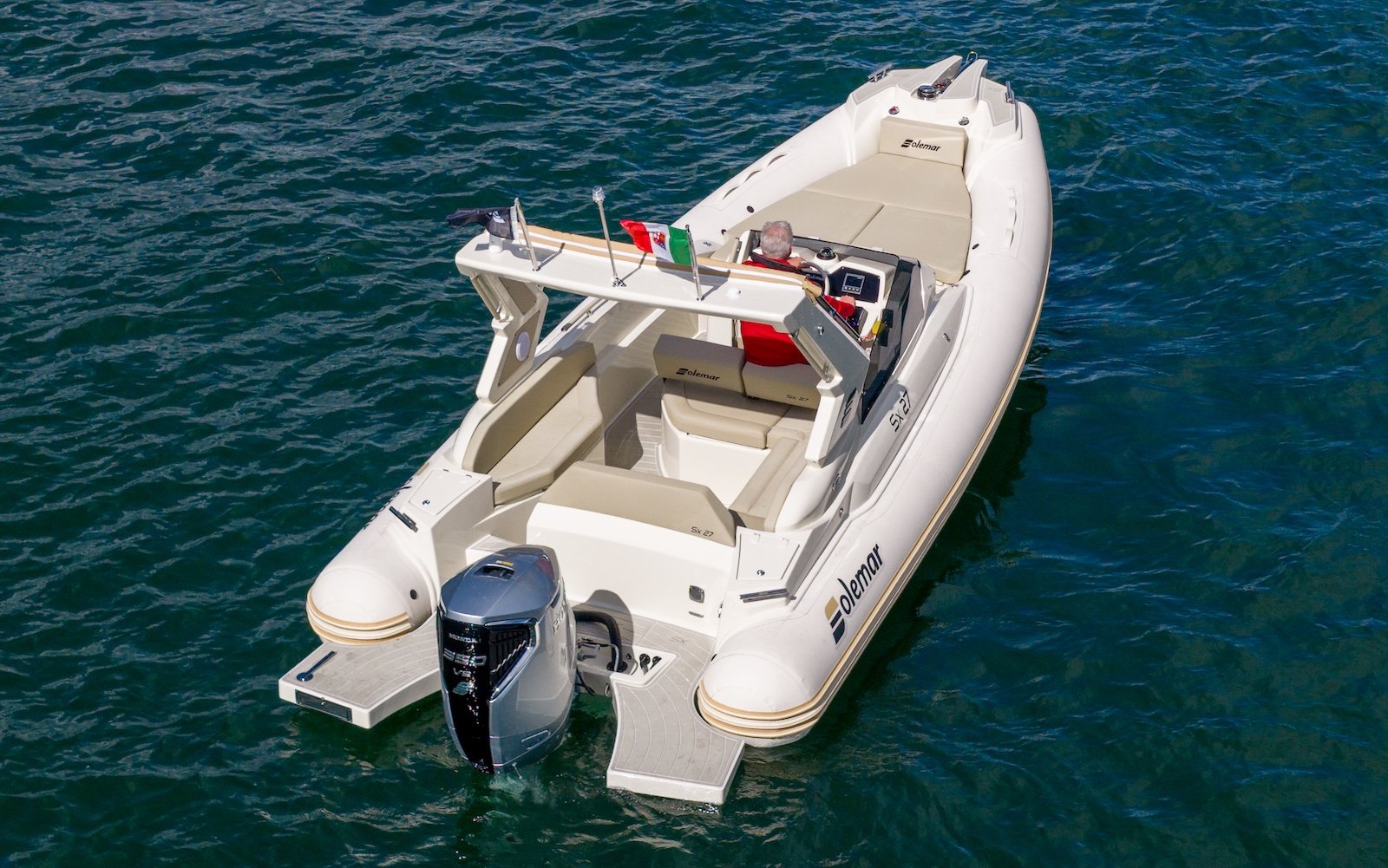
Back in port, it is time to explore the deck of the Solemar SX27. Stepping on board, the first thing that strikes us is the massive swallow-tail stern platform. This design element not only elegantly wraps around the large Honda outboard, but also guarantees disarmingly easy water access and reboarding, acting as a true “terrace on the sea.”
Stepping over the convenient stern walkthrough, we enter the dinette. As is well known, the Solemar shipyard is famous for extreme attention to detail and a strong focus on onboard ergonomics. In the cockpit, we find a large, wraparound U-shaped sofa that contours the entire area. In the center of this zone, a dedicated dining table can be set up for social moments; the latter, if desired, can be lowered using a telescopic support, transforming the entire aft dinette into a second, immense sunbed.
The Helm Station and Bow Area
Moving toward midships, we reach the helm station of the Solemar SX27. Here, the ergonomics border on perfection. The console houses all instrumentation in a clean, rational layout. We find Honda’s electronic throttles, smooth and ultra-precise, equipped with the highly useful trim support function (automatic trim adjustment based on speed and RPM) and numerous other advanced features. Taking center stage is the Honda onboard computer, a crisp display that provides us in real time with revs, speed, fuel consumption, and a multitude of engine parameters. Completing the setup are a sports steering wheel, compass, space for a generous additional chartplotter, all toggle switches for managing boat utilities, and the indispensable VHF radio.
Leaving the helm station and moving forward toward the bow, one appreciates the width and safety of the side deck. A high-class detail is provided by the practical steel handrails elegantly wrapped in fabric—a stylistic signature that elevates the perception of onboard luxury. Reaching the far bow, we are welcomed by a sunbed more than large enough to comfortably accommodate two adults. Concealed beneath this solarium is a true gem: lifting the structure reveals a deep, well-finished interior volume that serves as a highly functional changing room. Upon the owner’s request, this space can be fitted with a sink and marine toilet—an option that transforms the vessel, making it perfect for long days at sea in total privacy and comfort. Completing the forward layout is a very comfortable forward-facing seat integrated into the front section of the console; I am certain that, while underway, this will be one of the most popular spots for your guests.
Conclusions
After this intense day of testing, the verdict is clear. If you are looking for a Maxi RIB with a distinctive design, exceptionally well finished in terms of materials and onboard solutions, and capable of offering not only great comfort but also extraordinary high-speed performance and low fuel consumption, then the Solemar SX27 is without a shadow of a doubt the rigid inflatable boat you are looking for.
From Luca D’Ambrosio and The International Yachting Media, that is all for today. I look forward to seeing you at the next boat review!
Technical Specifications of Solemar SX27
Below is the summary table with all technical data of the tested RIB:
| Technical Specification | Detail |
| Manufacturer Shipyard | Solemar |
| Model | SX27 |
| Length Overall (LOA) | 8.50 m (up to 8.75 m with attachments) |
| Maximum Beam | 3.09 m |
| Beam (tubes deflated) | 2.48 m (Trailering width) |
| Tube Diameter | 0.65 m |
| Number of Chambers | 6 |
| Dry Weight (without engines) | 1750 kg |
| Maximum Passenger Capacity | 14 |
| Fuel Tank Capacity | 2 x 150 liters |
| Maximum Installable Power | 400 hp (221 kW) |
| CE Certification Category | B |