Someone say it’s bad luck and sailors must avoid it. But hangman’s knot was known on ships not only for the terrible purpose it is named back but also because it is very useful to recover objects fallen in water.
It’s, in fact, a knot which slides on the rope very well, it’s rather heavy and easy to tie. It gives its best on thick ropes but it is always efficient in many other circumstances.
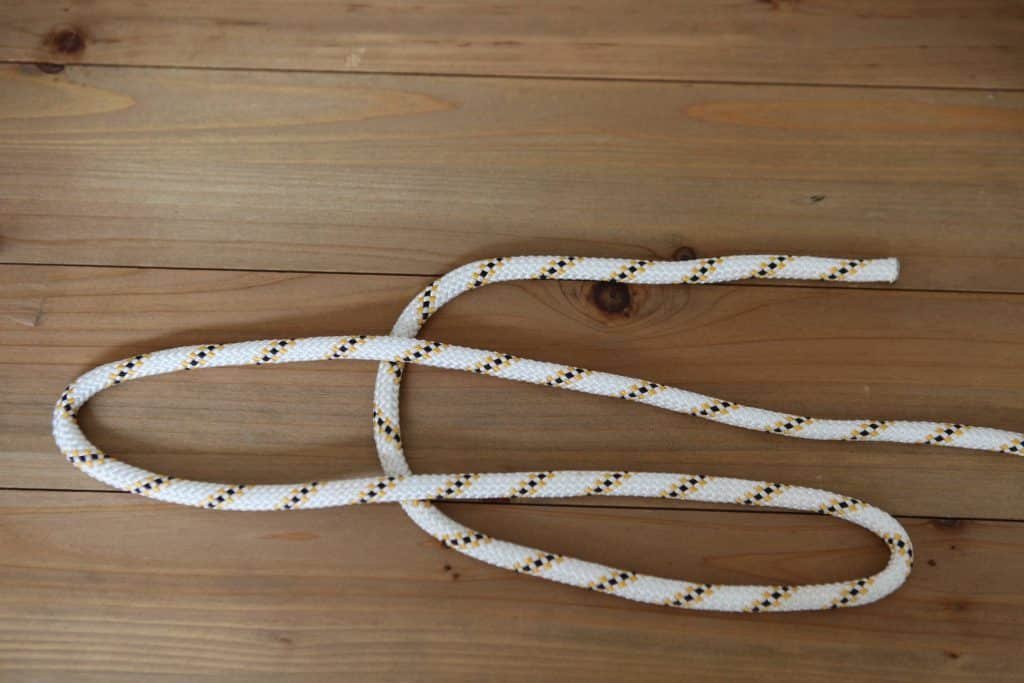
Since it has many coils, it requires a long rope. After a first loop, make another one next to it, by letting the end of the rope pass under it.
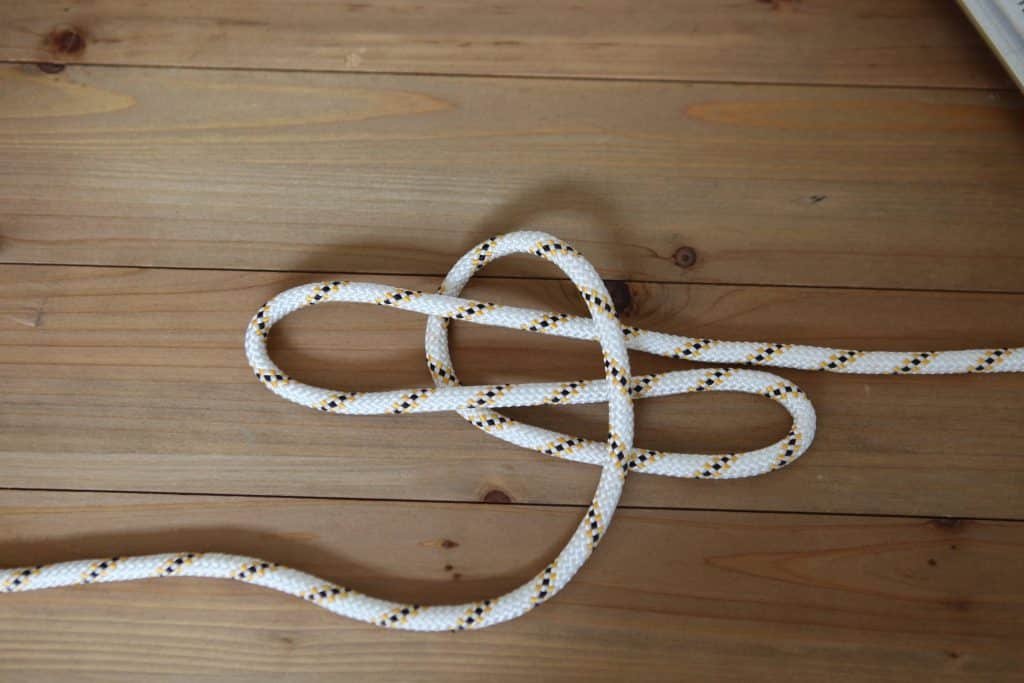
Now, it’s time to create a series of coils around the two loops. It’s important to keep coils clamped in order to avoid a long standing line.
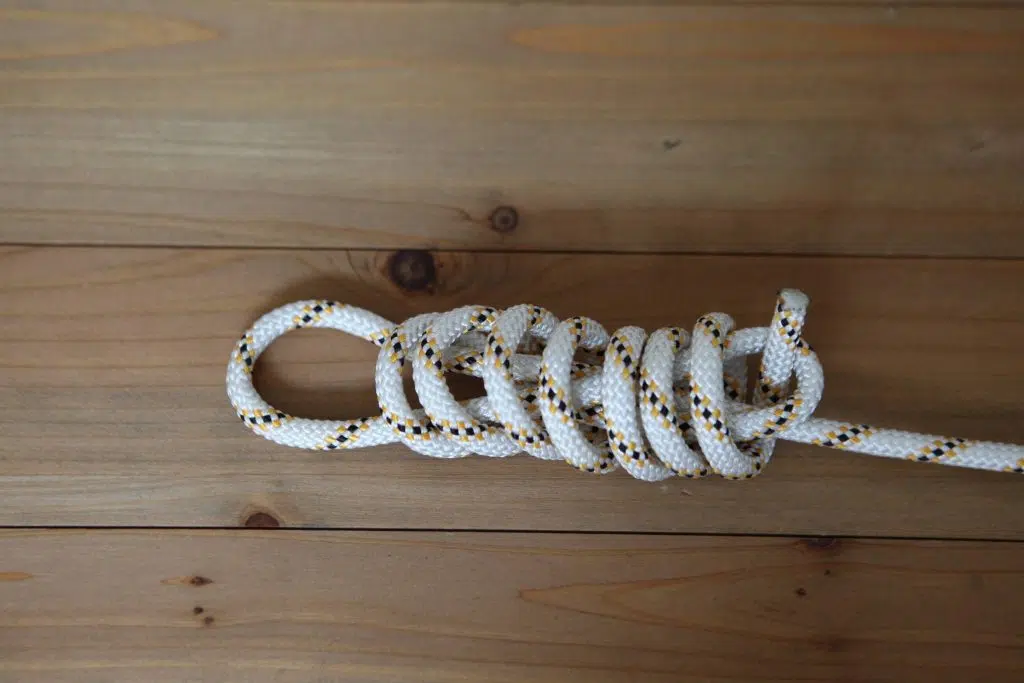
Finally, cross the end of the rope inside the final coil.
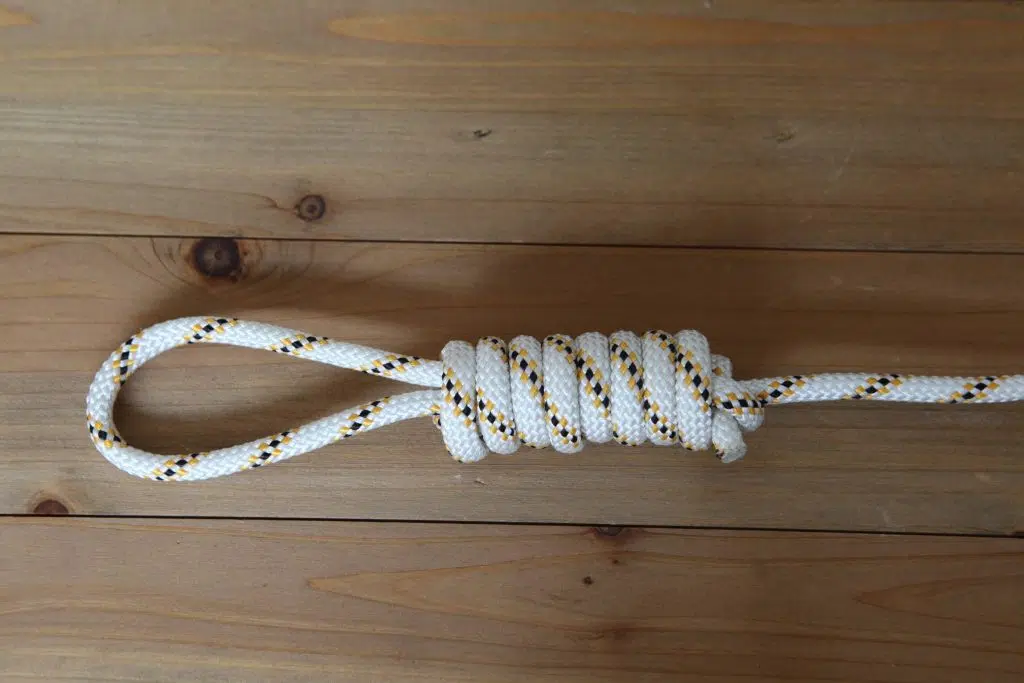
What’s the right number of coils to do? Tradition says 9 but someone suggest 13. I think 7 coils are perfect and not exaggerate.
The Hangman’s Knot at Sea: Boating Applications and Limitations
In the nautical field, the hangman’s knot loses its function as a slipknot to be adapted for uses where a compact mass is needed at the end of a rope. Its use on a boat differs significantly from its original purpose, primarily exploiting the weight generated by its coils.
Heaving lines: The most common maritime application is creating a weight for throwing a line. By pulling the loop completely closed until it disappears, the massive cylinder of rope created by the coils (usually between five and seven) turns into an excellent counterweight. This allows a sailor to throw a thin rope with precision and over a long distance towards a dock or another vessel. In this role, it serves as a simpler and quicker alternative to tie than the traditional “monkey’s fist”.
Boat fishing: In bottom fishing and trolling, miniature variants of this knot (often overlapping with the “Uni” knot or the blood knot) are widely used to tie nylon or fluorocarbon lines to hooks and swivels. The multiple-coil structure absorbs tension and distributes the load, preventing the line from cutting into itself under the strain of a catch.
Limitations as a fastening loop: As an actual anchoring knot, the hangman’s knot is strictly avoided in both recreational and professional boating. Being a pure slipknot, if subjected to strong traction, it would inexorably tighten around a cleat, a ring, or a piling. At sea, where quickly untying a line can be a matter of safety, a knot that jams under tension is highly dangerous. For this reason, to create a temporary and secure loop, the bowline is universally used instead, as it does not slip and can be easily untied even after being subjected to extreme loads.


27 Responses
thank you
Thanks
I needed this
Thanks
thanks
This will come in handy, thank you
nice
why images not show up?
Prolly since it’s been a while and code rotting occured
Sorry Guys, the article is now properly working
Thank you 😢
Thanks I just want to know how to do it right no mistakes
Are you ok?
Thanks ! Merry Christmas
Best simple guide. Others way too complicated
Thanks so much!!!
Best way to kill myself
thanks
i need this
Please everyone in the Comments, your not alone, I promise you, my email is joethestubbs@gmail.commif anyone ever needs someone to talk to
Thanks great knot for the greatest end.
I love you guys
love you too man
Thanks
Yeah I needed this because I love boats and not because life isn’t worth it…
thanks for the tutorial 🫶🏽
Thank you
Exactly what I was looking for. Thank you.