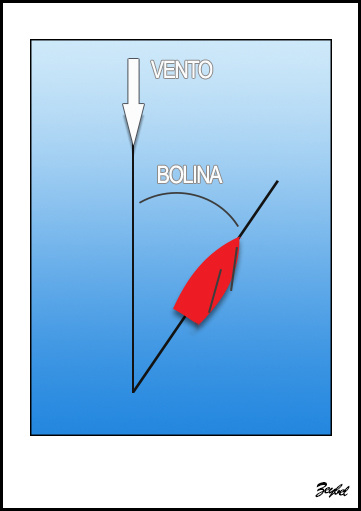
“ …. Till it remains an idea, an idea is only an abstraction; if I could eat an idea, I would have done my revolution”. Few things, like the provocation of this Giorgio Gaber’s song, can explain what a close-hauled is. It is the narrowest gait relative to the wind direction. An abstract concept the skipper can translate into a concrete fact in water, able to suddenly change everything few moments after the certainty he took the best close-hauled of his life.
Polar points, too, elaborated in the boatyards to establish which angle and speed a boat can reach in different wind conditions, are purely theoretical. A small variation (and sea and boats are the kingdom of variables) is sufficient to upset all plans. However, we can fix few rules in order to sail close to the wind. They are general rules, open to the variables of sea and wind. That is a real dogma.
First rule. Considering that, in theory, a medium close-hauled angle ( of a standard cruise boat) is 45-50 degrees compared to the real wind direction, the first thing to do is to head up in order to take this angle.
The sails hauled, we start to head up slowly while watching mainsail and genoa. When flow indicators start to move, we will slightly bear away in order to bring the boat back to the best angle.
At this moment, the second rule is to optimise. So, we act on the mainsail carriage, the kicking strap and the genoa carriage in order to improve the sails’ profile. This actions always depend on the conditions of the sea and the wind.
In general: with fresh wind, we will haul the kicking strap, and ,if possible, also the backstay, and, if necessary, we will bring the carriage leeward to make the boat balanced. In order to verify the right bending, we can consider the highest stick of the mainsail as a reference point and we will try to maintain it parallel to the sheetpoint.
If wind is light, we need larger sails. So, mainsail hauled and slack, jib carriage more advanced and halyard less hauled. When the boat speeds up, we will have an apparent stronger wind; consequently, we will be able to make sails thin and give some degrees to the weatherboard. But without exaggerating: when it is little windy, hauling and pressing the wind angle is useless.
Now, we can bring the mainsail carriage windward in order to reduce the bending, especially in the upper part. How much, as usual, it will be suggested by the boat itself. In general, we suggest to bring the boom at the same level as the backstay. But, in many cases, we can even bring it higher in order to bend the mainsail more.
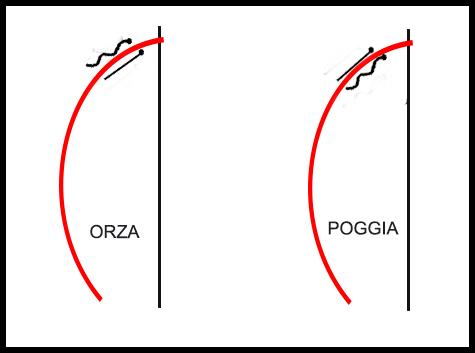
With the boat balanced and the best close-hauled angle, we only have to follow the changes of wind direction and correct the helmsman’s mistakes. In this case, the wind-vanes, or flow indicators may be very useful. A mnemonic rule says that it is necessary to make the boat pull over on the opposite site of the moving wind-vane. If the leeward wind-vane moves we must haul; on the contrary, we must bear away if the windward wind-vane moves.
Now, a little note about the sensations. It may happen that, while sailing in fresh or strong wind on a listing boat, we can have the impression to travel very fast. Actually, we are drifting leeward a lot compared to the right route and board life will be certainly a sort of hell.
So, and this is the third rule, a good close-hauled is that one you keep with a listing not higher than 20-25 degrees.
In order to maintain a good listing, it is necessary to work on the sail grease before, by increasing the binding and by flatting and hauling the base and the halyard and by moving the genoa carriage back. Finally, we have to haul the kicking strap and the backstay and, if necessary, we can reduce the sail.
When we sail close to the wind, a loaf wave can occur. In this case, maintaining the close-hauled means to work with the rudder: we have to head up slightly on the summit of the wave and bear away when we climb down, in order to avoid bumping and gain the necessary speed to climb up again.
A historic milestone for the oldest superyacht regatta in Europe. The Superyacht Cup Palma is…
If the choice is essentially fixed in the case of outboards—since they are practically only…
The new Halma Rib flagship is on its way: the official presentation of the new…
At Rio Yachts, the courage to dare and the desire to impress have never been…
A 56-footer set to redefine standards of style, comfort and build quality in the sailing…
Created just over a year ago, The International Yachting Media’s YouTube channel has achieved a…